
Generate a set of our Eurovision 2026 bingo cards and print out or play on your phones as you watch!
Eurovision Bingo
Customise Your Card
Tap to start
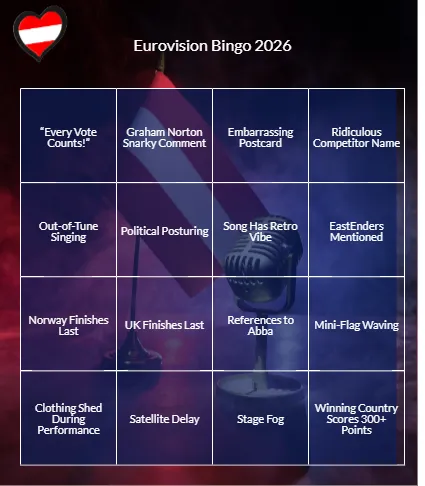
Eurovision Bingo 2026
BINGO
“Every Vote Counts!”
Graham Norton Snarky Comment
Embarrassing Postcard
Ridiculous Competitor Name
Out-of-Tune Singing
Political Posturing
Song Has Retro Vibe
EastEnders Mentioned
Norway Finishes Last
UK Finishes Last
References to Abba
Mini-Flag Waving
Clothing Shed During Performance
Satellite Delay
Stage Fog
Winning Country Scores 300+ Points
Eurovision Bingo
The Eurovision Song Contest is one of the most eagerly anticipated cultural events on the calendar and easily the most popular of our bingo card generators. It turns out that thousands of you like to include a game of bingo in your Eurovision watch party whether it’s in person or online.
There are still many people in the UK that treat Eurovision as a bit of a joke. But over the last 20-30 years the contest has acquired huge cultural, social and even political significance and breaks down borders by showcasing the music, languages and cultures of many nations and by being a paradigm of diversity and inclusion. This was reflected in the choice of United By Music as the slogan for Eurovision 2023; it’s now been adopted for all subsequent contests as a permanent slogan. Here’s what Martin Österdahl, the Executive Supervisor of Eurovision, said about that:
The Eurovision Song Contest is more than just a song competition; it’s a celebration of the power of music to bring people together. After over 20 years of using different slogans, and as we approach our 70th anniversary, we feel we have found one that truly encapsulates our brand.
By establishing a permanent slogan, we will have consistency in our message that music unites us all. It’s the perfect slogan to underline our values of inclusivity, equality, universality and celebrating diversity through music.
As the popularity of the Eurovision Song Contest continues to grow around the world, we believe using the same slogan annually will help our brand become even stronger.
If all that sounds a bit serious, never fear. The TV coverage is all about sheer entertainment!
We’ll bring you more news on that nearer the time, but for now you can watch videos of the national song selection finals and of the stage design concepton the official Eurovision YouTube channel.
The presenters in Vienna have been announced; Victoria Swarovski and Michael Ostrowski are the chosen ones.
All of the 2026 entries have been announced (scroll down for the list) and we’re delighted to see the UK go left field with the choice of LOOK MUM NO COMPUTER as this year’s entry.
As the contest gets closer, expect there to be lots of pre parties and even more YouTube coverage, especially once the rehearsals get under way. Some of the events coming up are:
- Nordic Eurovision Party 2026 in Oslo on 21st March
- Eurovision In Concert Amsterdam 2026 on 11th April
- London Eurovision Party 2026 on 19th April
- Eurovision Your Decision at the Royal Vauxhall Tavern, London from 6th – 16th May
How to Play Eurovision Bingo
First, generate your cards.
- Tap to start
- At this stage you can make any desired tweaks to your cards:
- We’ve set the grid size to 4×4 giving each player 16 items to look out for, but you can use the dropdown to change it to 3×3 or 5×5 if you’d like
- Don’t like our card design? You can change the background to an image of your choice and the colours to whatever you like.
- If you’re a true Eurovision fan you’re bound to have lots of ideas for things to go on the bingo card that we haven’t thought of, so go ahead and edit the list of items! Remove any of our items you don’t like and add your own great ideas. Just be sure to keep enough items on the list for everyone to get a different bingo card.
- Press Generate Bingo Cards
- If you want printed bingo cards, enter the number of cards you want and press Generate Printable Cards.
- You’ll be taken to a page of cards, all different from each other and unique to you.
- They can be printed from your browser (adjusting the scaling via the printer settings if necessary) or you can copy or bookmark the URL for printing later.
- Alternatively you can Invite through email.
- Each person you invite will receive a link to their very own unique bingo card, and you’ll get your own card too. (We don’t keep their email addresses).
- These cards can be played on your phone or other device – when you daub an item, it changes colour (and will stay changed, if you start playing at one of the semi finals and return later for the main event).
Once you’ve all got your cards, it’s time to watch Eurovision and mark off all the items as they happen, are shown on screen or are mentioned in the commentary. The winner is the first to complete a line, but if you’re watching both semi finals as well as the Grand Final you will probably want to play on to see who completes the most lines or gets full house.
PRO TIP – Print out more cards than you need so your guests can choose one they like the look of.
Eurovision Song Contest – List of Contestants
The 2026 Eurovision Song Contest will take place at Wiener Stadthalle in Vienna, following the Austrian win in 2025 with JJ – “Wasted Love”. The semi finals will be on 12th and 14th May 2026 and the grand final on 16th May 2026.
The lineup of participating countries has changed this year. Iceland, Ireland, the Netherlands, Slovenia and Spain are all boycotting the contest because of Israel’s participation. Bulgaria, Moldova and Romania return to the contest but this still makes for the smaller number of participating countries in more than 20 years.
There was also the possibility that entries from Portugal and Finland might not go ahead should the winners of those national finals decide not to compete.
The 2026 entries have now all been announced and are as follows:
- Albania – Alis – “Nân” (sung in Albanian) – 2nd semi-final
- Armenia – Simón – “Paloma Rumba” (sung in English) – 2nd semi-final
- Australia – Delta Goodrem- “Eclipse” (sung in English) – 2nd semi-final
- Austria – Cosmó – “Tanzschein” (sung in German) – in final, votes in 2nd semi-final
- Azerbaijan – Jiva – “Just Go” (sung in English and Azerbaijani) – 2nd semi-final
- Belgium – Essyla – “Dancing on the Ice” (sung in English) – 1st semi-final
- Bulgaria – Dara – “Bangaranga” (sung in English) – 2nd semi final
- Croatia – Lelek – “Andromeda” (sung in Croatian) – 1st semi-final
- Cyprus – Antigoni – “Jalla” (sung in English and Greek) – 2nd semi-final
- Czechia – Daniel Zizka – “Crossroads” (sung in English) – 2nd semi-final
- Denmark – Søren Torpegaard Lund – “Før vi går hjem” (sung in Danish) – 2nd semi-final
- Estonia – Vanilla Ninja – “Too Epic To Be True” (sung in English) – 1st semi-final
- Finland – Linda Lampenius and Pete Parkkonen – “Liekinheitin” (sung in Finnish) – 1st semi-final
- France – Monroe – “Regarde!” (sung in French) – in final, votes in 2nd semi-final
- Georgia – Bzikebi – “On Replay” (sung in English) – 1st semi-final
- Germany – Sarah Engels – “Fire” (sung in English) – in final, votes in 1st semi-final
- Greece – Akylas – “Ferto” (sung in Greek) – 1st semi-final
- Israel – Noam Bettan – “Michelle” (sung in English, French & Hebrew) – 1st semi-final
- Italy – Sal Da Vinci – “Per sempre sì” (sung in Italian and Neapolitan – in final, votes in 1st semi-final
- Latvia – Atvara – “Ēnā” (sung in Latvian) – 2nd semi-final
- Lithuania – Lion Ceccah – “Sólo quiero más” (sung in Lithuanian and English) – 1st semi-final
- Luxembourg – Eva Marija – “Mother Nature” (sung in English) – 2nd semi-final
- Malta – Aidan – “Bella” (sung in English and Maltese) – 2nd semi-final
- Moldova – Satoshi – “Viva Moldova!” (sung in Romanian) – 1st semi-final
- Montenegro – Tamara Živković – “Nova zora” (sung in Montenegrin) – 1st semi-final
- Norway – Jonas Lovv – “Ya Ya Ya” (sung in English) – 2nd semi-final
- Poland – Justyna Steczkowska – “Gaja” (sung in Polish and English) – in final, via 1st semi-final
- Portugal – Bandidos do Cante – “Rosa” (sung in Portuguese) – 1st semi-final
- Romania – Alexandra Căpitănescu – “Choke Me” (sung in English) – 2nd semi-final
- San Marino – Senhit – “Superstar” (sung in English) – 1st semi-final
- Serbia – Lavina – “Kraj mene” (sung in Serbian) – 1st semi-final
- Sweden – Felicia – “My System” (sung in English) – 1st semi-final
- Switzerland – Veronica Fusaro – “Alice” (sung in English) – 2nd semi-final
- Ukraine – Leléka – “Ridnym” (sung in English and Ukrainian) – 2nd semi-final
- UK – LOOK MUM NO COMPUTER – “Eins zwei drei” (sung in English) – in final, votes in 2nd semi-final
Not all European countries participate; some choose not to and others are not members of the European Broadcasting Union. Andorra, Bosnia and Herzegovina, Monaco and Slovakia are notable non participants for reasons other than Israeli participation. North Macedonia and Kosovo are yet to be admitted.
With all songs announced, Finland are currently the bookies’ favourite.
Top 5 Most Notorious Eurovision Moments of All Time
Where to begin? The competition has been careening from one year to the next since 1956. In amongst the numerous gems (Abba, Loreen, uh, Bucks Fizz, Dana International, Conchita Wurst) have been an awful lot of wardrobe malfunctions and some utterly cringeworthy performances. Here are five of the worst/best.
Ireland’s Turkey – 2008
Marking a low point in Irish musical history is Dustin’s Turkey puppet. Yes, that’s correct. Ireland happened upon the idea of using a puppet to represent the country at the 2008 event. ‘Where oh where did it all go wrong’ asked Dustin before his warbling intro morphed into a bizarre electro number. Where indeed. It’s a mystery.
Flying the Flag – 2007
The UK has had its fair share of ‘bad luck’ at Eurovision, despite entering some decent songs from the likes of Gina G and Cliff Richard. Rest assured, that ‘Flying the Flag’ isn’t one of them. The song’s flight attendant theme was sprinkled with some appalling innuendos which we won’t go into here. To top it all off, the song just wasn’t very good.
Cry Baby – 2003
Another embarassing fail from the UK. Jemini’s alright-ish ditty was ruined on the night by a performance that was about as off-key as you can get. In fairness, the monitors weren’t working but yeesh – what a shocker. By the time the song was over, most of Europe was in tears. The act also failed to score a single point.
Remedios Amaya – 1983
This rock-flamenco hybrid was inflicted upon continental Europe by some Spanish woman called Remedios Amaya. Backed by a plodding bass guitar and not a whole lot else besides, the meandering verse was frantically delivered by a feverish Remedios who sounded a lot like Yoko Ono singing on a good day. Nuff said.
Tune about a Treaty – 1990
Toto Cutugno (us neither) sang about the Maastricht Treaty back in 1990. Oh the excitement. Naturally, Eurovision voters loved it and awarded the drab number first place. Bedecked in a white suit and sporting an alarming mullet, Cutugno’s clench-fisted ode to the EU’s foundation treaty has aged very, very badly.
How it works?

Choose a theme to start building your free custom bingo cards

You can use our items and backgrounds or add your own.

All of the cards are printable and playable online

Generate a set of cards and you’ll each have a different card to play with.
Design Your Own
A template with instructions and step by step video tutorial for designing your own bingo cards for any occasion you like!
Design Your Own Bingo Cards
All our bingo cards are fully customisable – check out this video tutorial to learn how!